Showing posts with label articulate. Show all posts

Thursday, June 21, 2012

Prototyping an eLearning Project: The Angry Customer

Thanks to all of you who gave me feedback on my Mapping an eLearning Project post. It's nice to know that I am part of a support system. On that note, I've been working on creating a prototype to take to my "learners" and my stakeholders to review and test. I want to make sure my idea of interactivity matches the expectations of my audience. I also want to make sure my scenario will actually reinforce the actions I want the staff to take. In other words: Will staff behavior change after using this eLearning scenario? I have already brainstormed with my SME, but I want to get a user perspective before I move forward. At this moment, I am using Articulate Storyline to create this module, although I plan to use Captivate and ZebraZapps for others. Additionally, I have some concerns with various software, as I know ahead of time that the users are not allowed to download Flash on their computers. The organization does not have an LMS either, so I will have to publish the scenarios in an accessible way.
One of the branches that I created.
I've added some of the background slides to test them.
So let's get to it: One of the reasons I am enjoying Storyline is that it really connects with the creative and imaginative side of my personality. You can begin to see the fun I'm having with just a small screenshot of the Storyview. Branches and triggers are easy to add, and the illustrated characters are dynamic. Here is an example of the prototyping idea:
I have used very basic shapes as placeholders.
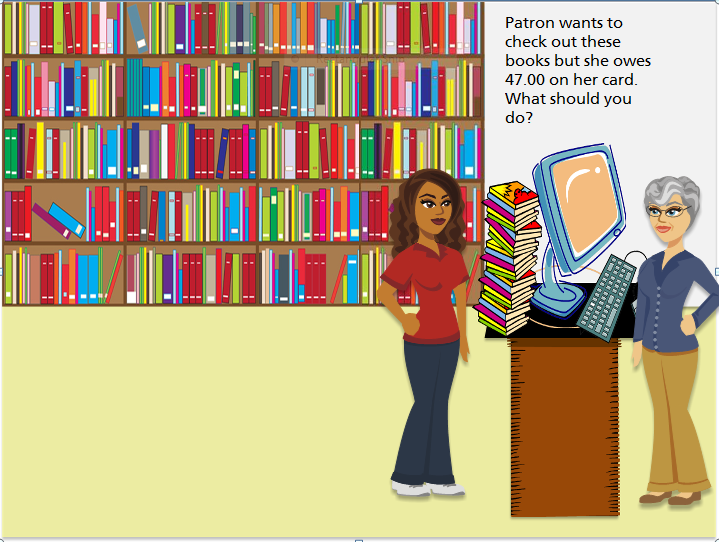
Later, I will add the backgrounds, like the example below:
This was created using Tom Kuhlman's approach to ungrouping clip art!
(Obviously I need to resize the computer!)
I will wait to create more backgrounds until I have tested the interactivity and script of the project. Even though I have a limited number of backgrounds for this project, it still takes some time to create each one. It makes no sense to do that until the prototype is approved by the very people who will be using it--the learners

Monday, May 14, 2012

eLearning Challenges: Why Graphics Aren't Everything

I grabbed your attention, didn't I? But can I keep it?
There have been a rush of new tools out there which are helping people create online learning programs. Articulate Storyline is one, and Zebrazapps is another. As excited as I am about these new technologies, it is really important to recognize that graphics don't create learning. Over and over I have seen great graphics on one screen, then confusing multiple choice text-based questions on the next. Or, a choose your-own-avatar scenario, which then turns into a true and false screen.
Now we have the tools, so why do we keep choosing text-based quizzing as our learning environment of choice? I have made the same mistakes, and I am trying to fix them. When I get discouraged, I just keep repeating Connect with Haji Kamal, Connect with Haji Kamal, to remind myself that great elearning can take place. 

Wednesday, March 14, 2012

Exceptional Instructional Design Models

During the last few days, I have taken some time to explore various models of online learning. Many of you in the design community will be familiar with these two examples, but I feel that it is worth it to reiterate how effective this type of instruction can be. The first example by the company eLearnerEngaged, uses Articulate (with other software) to create Broken Co-workerCathy Moore ("Let's save the world from boring e-learning!" is her tag-line) has posted her company's work for the U.S. Army. This Flash example called Connect with Haji Kamal is one of my favorites because each of the characters are well-developed and have their own input. 
What I like about both examples is that they are both visual and scenario based. Each demonstrates the use of the "branching" concept to teach interpersonal communication skills. By allowing users to make decisions which change the outcome of the learning scenario, both are effective in teaching a skill that is difficult to convey in the online learning environment.